Baby towels used to be a simple category. Soft, absorbent, maybe a cute animal hood, that was the whole brief. In 2026, that’s changed. Parents are reading labels more carefully, hotels and spas with baby-friendly amenities are asking tougher sourcing questions, and retailers are stocking fewer “cute” towels and more towels that can actually back up a sustainability claim.
For wholesale buyers, hospitality procurement teams, and retailers building out a baby linen range, this shift matters. It’s no longer enough to offer a soft towel at a good price point. Buyers want to know what the fabric is made of, how it was processed, and whether the factory behind it can prove any of it.
This guide breaks down the five biggest baby towel trends shaping sourcing decisions this year, and what to look for before you place a bulk order.
Why Sustainability Now Drives Baby Towel Buying Decisions
Babies have thinner, more permeable skin than adults, which means anything that touches it including the fabric they’re dried with after every bath, gets absorbed faster. That single fact has quietly reshaped an entire product category.
Three forces are pushing this trend forward at the same time:
- Parental awareness. More parents now actively check for organic certifications, chemical-free dyes, and fabric origin before buying baby textiles.
- Retailer risk management. Retailers selling baby products face closer scrutiny on chemical safety, so they’re pushing that requirement back onto manufacturers.
- Hospitality and spa demand. Family resorts, baby-friendly hotels, and maternity clinics are adding baby amenity kits to their guest offering, and they need supply partners who can meet both comfort and compliance standards at volume.
With that context, here are the five trends defining the category this year.
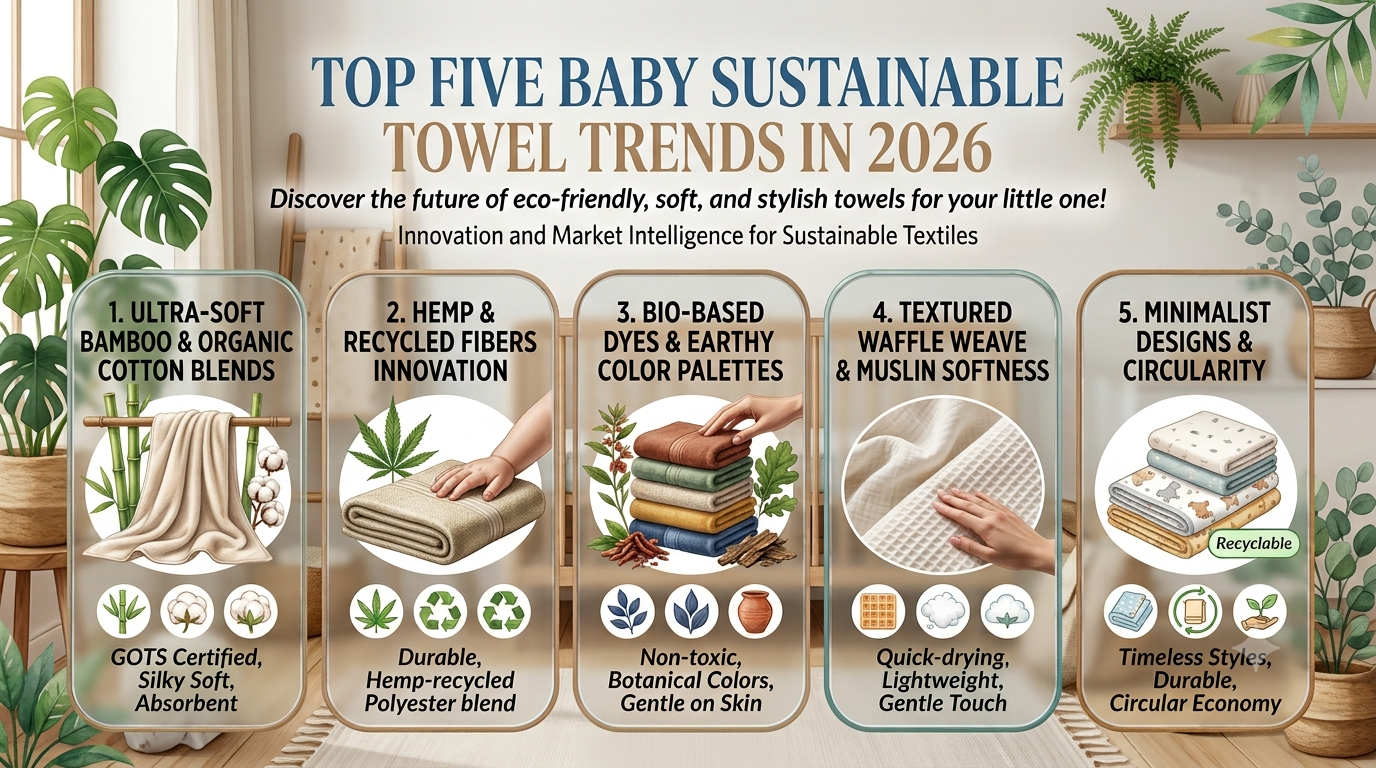
1. Organic and Natural Fiber Fabrics Are Now the Baseline, Not the Upgrade
A few years ago, organic cotton baby towels were positioned as a premium add-on. In 2026, they’re closer to a baseline expectation for any serious baby linen range.
Two fibers are leading this shift:
- Organic cotton, grown without synthetic pesticides or fertilizers, prized for its softness and strong absorbency.
- Bamboo-derived fabrics, valued for their naturally breathable structure and smooth hand-feel, which suits sensitive newborn skin especially well.
For buyers, the practical takeaway is this: ask for the actual certification, not just the word “organic” on a spec sheet. A fabric labeled organic without a traceable certification is a marketing claim, not a guarantee. Reputable manufacturers should be able to share testing documentation, including recognized independent checks such as the OEKO-TEX Standard 100 certification, which screens textiles for harmful substances before they’re cleared for baby and infant use. If a supplier can’t point to something similar, treat that as a gap worth asking about rather than an oversight.
If you’d rather skip the vetting process altogether, our own organic baby towel range is already sourced and tested to meet this kind of standard, so the certification work is done before the towels reach your catalog.
2. Skin Safe, Low Impact Dyeing and Finishing
The fiber is only half the story; how it’s dyed and finished matters just as much. Harsh dyes, formaldehyde-based finishing resins, and chemical softeners have historically been common in mass-market towel production because they’re cheap and fast.
That’s changing for baby-specific lines. In 2026, buyers are increasingly requesting:
- Low-impact or plant-based dyes
- Formaldehyde-free finishing
- Mechanical softening (through weaving and washing techniques) instead of chemical softening agents
This matters most for hooded towels and washcloths, which sit directly against a baby’s face and scalp. If you’re sourcing for a hospitality baby-amenity line or a retail nursery collection, this is one of the first questions to raise with any supplier, not an afterthought. Our hooded baby towels are finished using this exact low-impact process, which is one reason repeat buyers keep coming back to the same batch specs order after order.
3. Lightweight, Fast Drying Construction Without Losing Absorbency
Older-generation baby towels leaned heavily on thickness to signal quality, the thicker the towel, the more “premium” it felt. That assumption is fading.
Modern weaving techniques, particularly double-loop terry construction, now allow a lighter-weight towel to hold more moisture per gram of fabric than older, bulkier designs. The practical benefits for buyers and end users are significant:
- Faster drying between uses, which matters for busy households, daycare centers, and hotel laundry turnaround
- Lower shipping and storage weight, which affects freight cost on large wholesale orders
- Reduced risk of mildew or sour odor from towels that stay damp too long
For any buyer working with high turnover, hotels, spas, or subscription baby-box brands, this trend directly affects operating cost, not just guest comfort.
4. Transparent, Traceable Supply Chains
Sustainability claims are worth very little without a supply chain that can back them up. In 2026, more buyers are asking manufacturers a direct question: can you show me where this fabric actually came from?
This has pushed manufacturers toward:
- QR codes or batch codes linking back to sourcing and production data
- Documented ethical labor practices at the factory level
- Clearer country-of-origin and mill-level sourcing information
If you’re a retailer or distributor building a baby collection with a sustainability angle, this traceability isn’t just a nice-to-have, it’s what protects you from having to walk back a green claim later. Ask your manufacturer for documentation up front, before the first purchase order, not after a customer complaint.
5. Minimalist, Gender Neutral Designs Over Loud Prints
The visual side of the category has shifted too. Bright, character-heavy prints haven’t disappeared, but there’s clear growth in muted, gender-neutral colorways soft beige, sage green, warm grey, and dusty blue are outselling the primary-color prints that dominated a few seasons ago.
This works in buyers’ favor in a few practical ways:
- Neutral designs are easier to gift and resell, since they aren’t tied to a specific gender assumption
- They photograph better for e-commerce and social content, which matters if you’re selling direct-to-consumer
- They tend to have a longer shelf life in a catalog, since they aren’t tied to a trend-driven print cycle
For hospitality buyers stocking baby amenities across multiple properties, neutral designs also simplify inventory, one design works across every room type instead of needing separate stock for different guest profiles. Our current run of gender-neutral baby towel sets was built with exactly this kind of multi-property stocking in mind.
What This Means for Wholesale and Hospitality Buyers
Put together, these five trends point to one underlying shift: baby towels are being evaluated the same way buyers already evaluate adult hospitality linen, on fiber quality, safety documentation, drying performance, and supply chain transparency, not just softness and price.
If you’re sourcing baby towels at volume, a short checklist before you commit to a supplier:
- Ask for fiber certification documents, not just label claims
- Confirm the dyeing and finishing process is chemical-safe for infant skin
- Request drying-time and absorbency data if you’re managing laundry turnover at scale
- Ask whether the manufacturer can trace fabric back to its source
- Consider neutral colorways if you’re stocking across multiple properties or resale channels
Looperry works directly with hotels, resorts, spas, and retail buyers to source baby and infant towels that meet these standards at wholesale volume. You can browse the current range in our baby collection or reach out to our team for private label and bulk order options.
FAQs About Baby Towel
What fabric is best for baby towels in 2026?
Organic cotton and bamboo-derived fabrics are currently the top choices, valued for softness, breathability, and lower risk of skin irritation compared to conventional cotton-polyester blends.
Are hooded baby towels still popular?
Yes. Hooded towels remain a staple, but the design has evolved; deeper hoods, wider wrap wings, and better-fitting construction are now standard rather than optional extras.
How can buyers verify a “sustainable” or “organic” claim?
Ask for third-party certification documents (such as GOTS or OEKO-TEX), not just marketing language. A supplier that can’t produce documentation on request is a red flag for bulk sourcing.
Why does towel weight matter for wholesale buyers?
Lighter, well constructed towels dry faster, reduce mildew risk, and lower freight costs on large orders, all of which affect operating margins for hotels, spas, and retailers at scale.