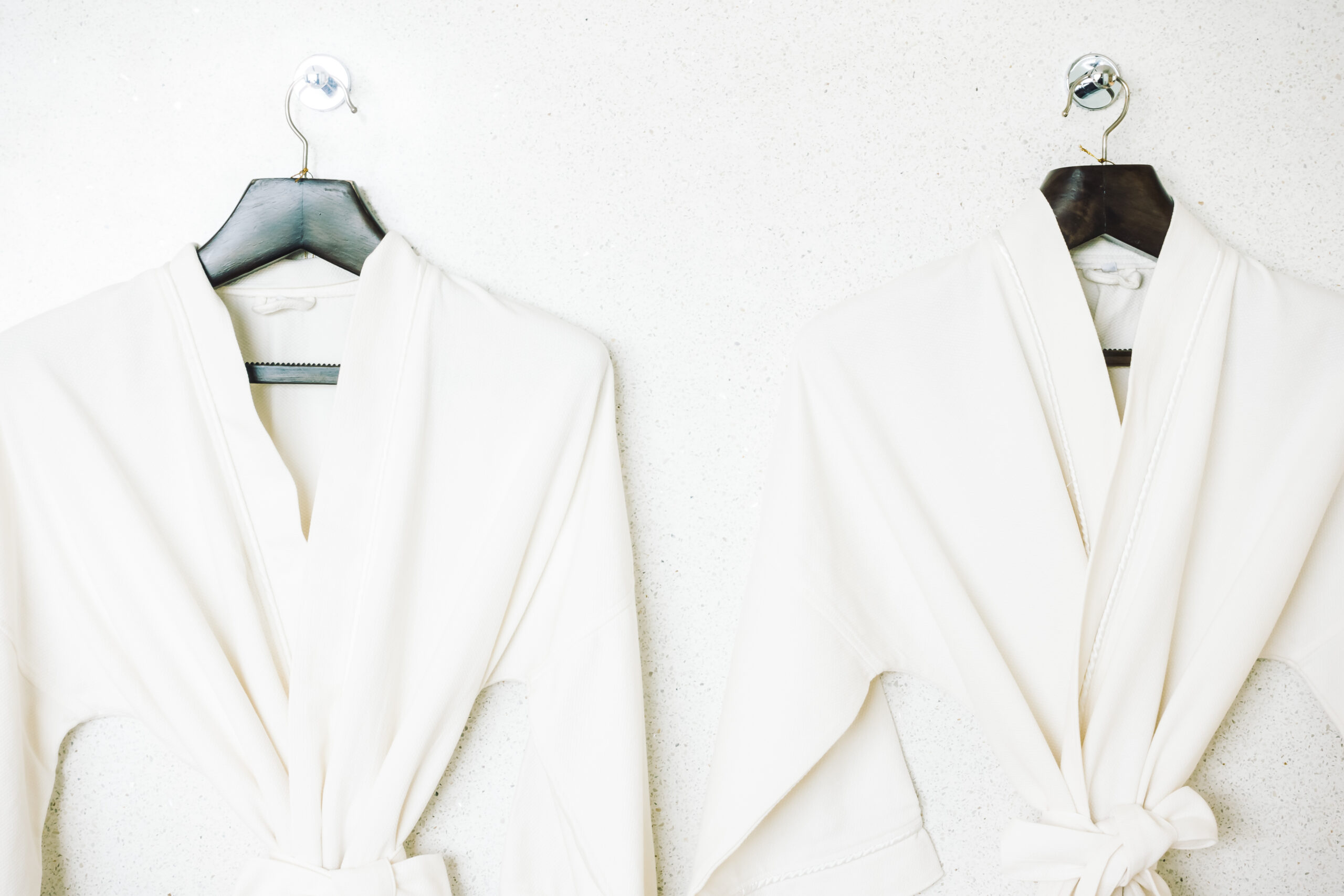
A hotel bathrobe is one of the few amenity items that a guest interacts with at peak comfort immediately after a shower, late at night, or during a quiet morning before checkout. It is a moment with no distraction and no competing stimulus. What the guest feels in that moment is what they remember, and what they describe in a review. For hotel operators responsible for linen procurement, this means the bathrobe decision carries an outsized share of the guest experience outcome relative to its line-item cost.
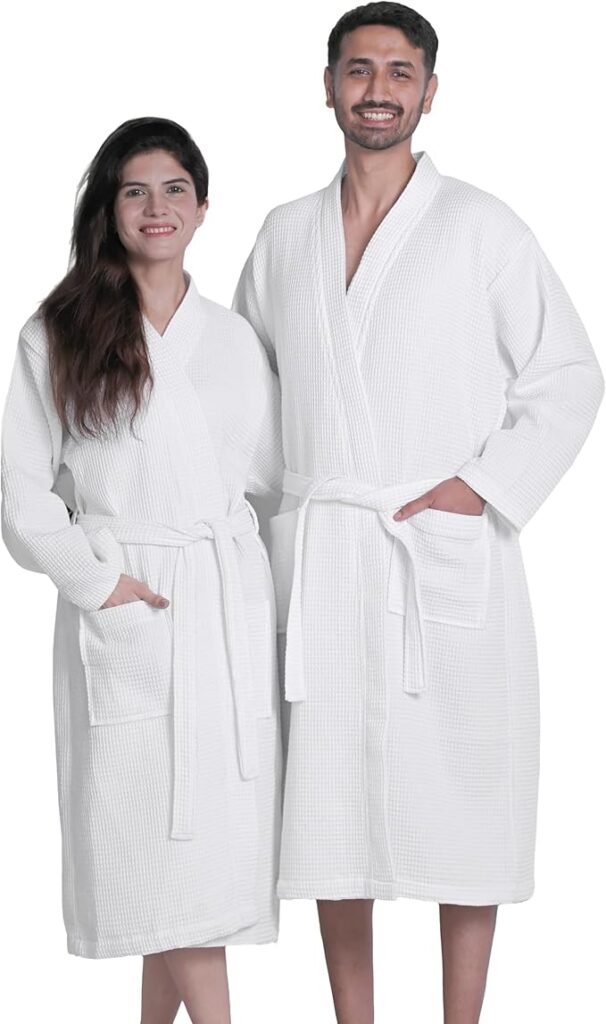
White waffle robes have become the standard-of-choice for US hotels ranging from select-service to upper-upscale properties. This guide covers the industry standards that drive that preference, the specifications that separate commercial-grade robes from catalog-grade ones, and the stocking frameworks that keep waffle robe programs running without inventory gaps or quality drift.
Why White Waffle Has Become the Hotel Standard
The shift from terry to waffle weave in US hotel bathrobe programs has been driven by four operational realities, not aesthetic trend alone:
- Laundry throughput: Waffle robes dry 20–35% faster than terry robes of comparable quality due to the honeycomb weave’s superior airflow. In a hotel laundry running 200+ robe cycles per week, this directly increases daily processing capacity without additional equipment.
- White maintenance: The flat weave surface of a waffle robe is easier to bleach-treat evenly than terry pile, where uneven penetration causes patchy yellowing over time. White waffle robes hold their optical brightness through significantly more wash cycles than white terry equivalents.
- Guest perception alignment: Contemporary US hotel design has shifted toward cleaner, lighter aesthetics. Waffle weave reads as spa-forward and intentional rather than institutional — a distinction that registers with guests even when they cannot articulate the specific fabric difference.
- Embroidery performance: The flat surface of waffle fabric accepts embroidered logos with sharper detail than terry pile, making it the superior base for any hotel running a branded robe program.
The waffle robe has not replaced terry because it is softer terry is still plush. It has replaced terry because it performs better across every operational metric that matters at commercial scale: drying speed, whiteness retention, embroidery clarity, and cost-per-use over a full replacement cycle.
Specification Standards by Hotel Tier
Not every hotel property requires the same Waffle Bathrobe specification. Procurement teams should match robe specs to property tier over-specifying costs margin without proportional guest experience return; under-specifying creates quality gaps that show up in satisfaction scores.
| Hotel Tier | GSM Range | Fiber Spec | Collar Style | Branding | Target Wash-Cycle Life |
| Budget / limited service | 180–210 GSM | Cotton-poly blend acceptable | Kimono | Woven interior label | 75–100 cycles |
| Select service / midscale | 210–240 GSM | 100% ring-spun cotton | Shawl or kimono | Embroidery or woven label | 120–160 cycles |
| Full service / upscale | 240–270 GSM | 100% combed ring-spun cotton | Shawl collar | Left-chest embroidery | 160–200 cycles |
| Upper upscale / luxury | 260–300 GSM | 100% ELS or Turkish cotton | Shawl with piping detail | Embroidery + collar label | 200+ cycles |
Specifying above your tier is a common procurement error. A luxury-spec robe in a midscale property does not move the needle on TripAdvisor scores proportionally to the added cost guests calibrate their experience expectations to the property tier before arrival. Spend the GSM and fiber premium where the guest is predisposed to notice it.
The 5 Specification Points That Determine Commercial Suitability
When reviewing supplier samples or spec sheets, these five points separate a robe built for commercial laundry from one built to look good in a product photo:
- Waffle cell depth and density: Deeper cells with tighter grid spacing indicate a higher-quality weave with greater surface area. Shallow or irregular cell patterns suggest lower thread count in the base construction the first sign of a robe that will flatten and lose its texture within 30–50 wash cycles.
- Belt loop construction: Double-stitched, wide belt loops are the mark of a commercially rated robe. Narrow single-stitched loops the most common failure point in cheaper robes begin pulling free within 20–40 cycles under commercial laundry agitation.
- Hem and cuff finishing: Rolled or double-stitched hems resist fraying under repeated washing. Overlock-only finishing (a single pass of an overlocker) is a cost-cutting construction choice that shortens the robe’s functional life significantly.
- Pocket attachment: Side patch pockets should be secured at all four corners, not just the top edge. Bottom-corner loose pockets bag out and detach faster a visible quality issue that guests notice when pockets are in use.
- Fiber uniformity across the batch: Request five or more samples from a single production batch. Weigh them individually — batch GSM variance greater than ±8% indicates inconsistent yarn density across production runs, which will produce visible quality inconsistency across your inventory.
Par Level Framework for Hotel Bathrobe Programs
Par level is the total robe inventory required to maintain uninterrupted service through one complete laundry cycle. Undershooting par is one of the most common and guest-visible failures in hotel linen programs.
The industry-standard three-par model:
| Par Level | Location | Status |
| Par 1 | Guest rooms currently occupied | In active use |
| Par 2 | Laundry department | Soiled, washing, or drying |
| Par 3 | Linen room — clean inventory | Staged and ready for assignment |
For a 150-room full-service hotel with one robe per room: 150 rooms × 1 robe × 3 par = 450 robes as the minimum base inventory. Add the following buffers on top of base par:
- Spa or pool access: +15–20% guests use additional robes beyond in-room allocation.
- Inspection hold: +5% robes pulled for quality review, loose thread repair, or brightness assessment before reissue.
- Attrition buffer: +8–10% accounts for annual loss to guest removal, irreparable damage, and retirement from visible circulation.
| 3× Minimum par multiplier for uninterrupted service | +20% Buffer for properties with spa or pool access | 160+ Wash cycles commercial-grade waffle robe target | 35% Faster drying vs terry at equivalent GSM |
Stocking and Rotation Best Practices
A well-specified robe inventory degrades faster than it should when stocking and rotation practices are inconsistent. These are the operational standards used by US full-service hotel linen programs to extend robe lifespan and maintain visual quality across guest turns:
- FIFO rotation: First-in, first-out rotation ensures older robes cycle out of storage before newer inventory, preventing new robes from doing all the laundry work while older stock sits folded. Linen teams should be trained explicitly on FIFO robe rotation it is routinely ignored in properties that have not made it a documented procedure.
- Brightness assessment cycle: Schedule a visual brightness check on the full robe inventory every 60 days. Remove any robes showing yellowing, gray cast, or surface flattening from guest room circulation and redirect to back-of-house use (staff changing areas, storage lining) before retirement.
- Per-robe laundry tracking: Large properties use laundry tracking tags RFID or simple embroidered batch codes to monitor individual robe wash counts. This allows retirement decisions based on actual cycle data rather than visual inspection alone, and dramatically improves budget forecasting for replacement cycles.
- Seasonal par adjustment: Adjust inventory par levels before peak occupancy periods (summer, holidays, conference season) to avoid shortfalls during high-demand weeks. A linen shortfall that forces housekeeping to issue substandard robes during a peak weekend is the costliest possible version of an under-par inventory.
Building a Reorder Program That Prevents Inventory Gaps
Most hotel linen programs replace robes reactively ordering only when a visible shortage forces the issue. The result is emergency procurement at non-competitive pricing, inconsistent quality across batches, and gaps during the lead-time window between order and delivery.
A proactive reorder trigger solves this. Set your reorder point at 115–120% of your base par level the moment your clean inventory drops to that threshold, the reorder is placed. With a standard 8–12 week lead time for commercial waffle robe orders, a reorder triggered at 115% of par ensures new inventory arrives before the existing stock reaches critical levels, even during an occupancy spike.
Looperry‘s B2B program is built for recurring hotel linen relationships with standing order terms available for properties that want guaranteed quarterly replenishment at locked pricing, so procurement teams spend less time managing individual reorders and more time focused on the operations decisions that actually require their attention.
White waffle robes at scale are not a set-and-forget purchase. They are a managed inventory asset. The properties whose robe programs run without friction are the ones that treat them that way and whose guests never encounter a thin, yellowed, or belt-loose robe on the back of a bathroom door.