Choosing the wrong bathrobe supplier at scale costs more than the per-unit price difference. A supplier that ships inconsistent GSM, misses lead times, or fails to maintain quality across reorders does not just create a procurement headache it creates guest-facing service failures that appear in reviews and satisfaction scores months after the purchase decision was made.
This checklist is built for procurement managers, hotel operations leads, and spa buyers who are actively evaluating commercial bathrobe suppliers in the US market. It covers every dimension that separates a reliable long term wholesale partner from a low-price vendor that creates problems at volume.
Step 1: Verify Product Specification Accuracy
The first test of any supplier is whether their products match their advertised specifications. In the commercial linen industry, GSM variance, fiber content misrepresentation, and inflated wash cycle claims are common enough to warrant independent verification before any bulk commitment.
Request a minimum of five product samples per SKU before placing an order. Do not accept a single sample batch consistency is the issue, not whether one perfect unit exists. When samples arrive, verify:
- GSM weight: Weigh each sample against the stated spec. A supplier claiming 230 GSM should deliver within ±5% of that figure across all five samples. Variance greater than 10% indicates inconsistent production.
- Fiber content: Request the supplier’s third-party lab test confirming cotton percentage. Many suppliers blend cheaper polyester without disclosing the ratio accurately on spec sheets.
- Construction details: Check belt loop stitching, collar seaming, and pocket attachment points. These are the first failure points under commercial laundry stress, and they tell you immediately whether the construction is designed for institutional use or retail.
Step 2: Run a Commercial Wash Test
A bathrobe that looks perfect on arrival can deteriorate rapidly under institutional laundry conditions. Before approving any supplier, run the sample set through a minimum of 20 industrial wash cycles at your facility’s standard settings temperature, detergent type, and bleach protocol.
After 20 cycles, evaluate the following:
| Quality Metric | Acceptable Standard | Failure Signal |
| GSM retention | Within 5% of original weight | Loss greater than 5% |
| Waffle cell integrity | Cells maintain depth and definition | Flattening or pilling visible |
| Color (white retention) | Bright white, no yellowing | Any yellowing or gray cast |
| Belt loop strength | No stretching or separation | Any loop distortion |
| Hem and seam condition | No fraying or thread pull | Any unraveling at edges |
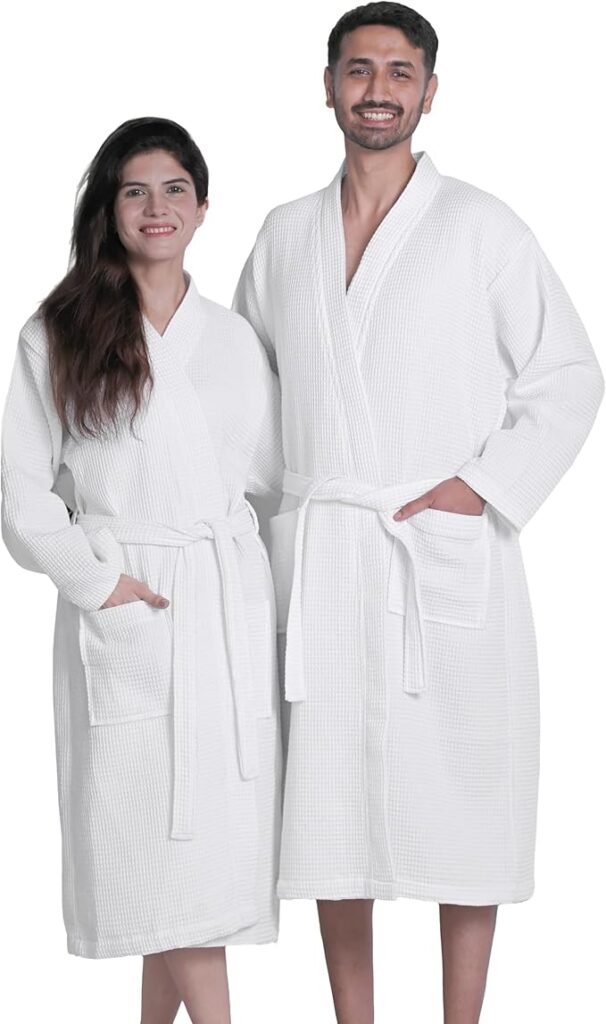
A Waffle Bathrobe designed for commercial hospitality should maintain its structural integrity through at least 75 institutional wash cycles. The 20-cycle test gives you a reliable early indicator of whether the product will reach that threshold.
Step 3: Evaluate Certification and Compliance Documentation
For US hospitality buyers, three certifications carry the most weight when evaluating a commercial linen supplier:
- OEKO-TEX Standard 100: Confirms the fabric has been tested for harmful substances and meets safety standards for skin contact. This is particularly important for spa and healthcare settings where guests or patients have extended skin contact with the robe.
- GOTS (Global Organic Textile Standard): Required if your property is pursuing organic or natural fiber claims in guest communications or sustainability reports. GOTS-certified cotton has verified supply chain documentation.
- ISO 9001 Quality Management: Indicates the supplier operates under a documented quality control system. Not all commercial linen suppliers hold this certification, but its presence signals consistent production standards and systematic defect tracking.
Request the actual certificate documents, not just a claim of compliance. Every legitimate certification includes a certificate number, an issuing body, and an expiration date. Verify these independently if the order volume justifies it.
Step 4: Assess Lead Time Reliability and Reorder Capacity
A supplier’s quoted lead time and their actual delivery performance are often two different numbers. Before committing to a primary supplier relationship, verify:
- Initial order lead time: Confirm the lead time in writing as a contractual term, not a verbal estimate. For bulk orders over 300 units, 8–12 weeks is standard. Any supplier quoting under 6 weeks for a first large order without a clear explanation of inventory availability warrants additional scrutiny.
- Reorder lead time: Once an initial order is placed, reorder lead times are typically shorter if the supplier maintains base inventory of your approved SKU. Confirm this explicitly some suppliers start production from scratch on every order, regardless of previous relationship.
- Capacity documentation: Ask the supplier to confirm their monthly production capacity and current order backlog. A supplier at 95% capacity cannot reliably absorb a large rush reorder if your property experiences unexpected attrition.
The real test of a supplier relationship is not the first order — it is the third. Ask prospective suppliers for references from clients who have completed at least two full reorder cycles. The suppliers who perform consistently across reorders are the ones worth building long-term contracts with.
Step 5: Request US Client References
No evaluation step is more valuable and more frequently skipped than speaking directly with the supplier’s existing US hospitality clients. Request contact details for two or three accounts at a comparable scale to your operation.
When you make contact, ask three specific questions: Did the product match the specification across multiple production batches? Were lead times met consistently? How did the supplier handle a quality dispute or a defective shipment?
A supplier confident in their product quality and client relationships will provide references without hesitation. Hesitation on this point is a signal worth taking seriously before committing to a volume order.
Step 6: Compare Total Cost of Ownership, Not Unit Price
The final evaluation step is a cost-per-use calculation, not a price comparison. A robe that costs $14 per unit and lasts 60 wash cycles has a higher cost-per-use than a $19 robe that lasts 120 cycles. Over a 12-month operating period, the cheaper robe costs more.
| Scenario | Unit Price | Estimated Wash Cycles | Cost Per Use |
| Budget supplier | $13 | 50–60 cycles | $0.22–$0.26 |
| Mid-tier supplier | $18 | 90–110 cycles | $0.16–$0.20 |
| Premium supplier | $24 | 130–160 cycles | $0.15–$0.18 |
Looperry provides full cost-per-use documentation alongside its commercial bathrobe range including third-party wash-cycle test results so procurement teams can complete this calculation with verified data rather than supplier estimates.